"This is, as I said and believe, a book about Heaven, but I must say too that it has been a close call. For I have wondered sometimes if it would would not finally turn out to be a book about Hell..."
Just finished reading Jayber Crow by Wendell Berry. This is the life story of J. Crow who is forced as a child to grow up in an orphanage in 1920's Tennessee. He spends his entire life within a small radius, but mostly in the small town of Port William. Following the orphanage Jayber Crow finds himself in seminary where he wrestles with hard questions of faith and God. In a conversation with a New Testament professor, Crow sets out on a life-long pursuit of finding out how God is working in the world.
Crow ends up as the bachelor barber of Port Williams. He finds himself at home in this small town where things move and change slowly. The book is about Crow observing and pondering the changes that happen through the decades. He sees the old ways of living, saving, farming and business change. He watches families in disputes. He sees friends come and go. He falls in love with Mattie Chatham. The only problem with this love... she's already married. Crow holds his feelings inside for decades, never betraying his feelings even during occasional meetings in the woods.
Through the novel Berry critiques the "progress" of the 20th century. Berry criticizes the industrialization of the world and of farming. The Economy and The War are the two forces which Jayber sees working against his little town. He sees people repeatedly sacrificed for The War and sees numerous townsfolk fall under the pressure of The Economy.
This story reminded me of stories from my Grandpa growing up on a Depression farm. I thought of how I've seen my own world transformed for the sake of The Economy. I remember my Grandma Ulm's house torn down to be replaced by a corporate building. The hill we always would go sledding on in Ohio was turned into a drainage pond a few years ago to accommodate the new housing development going in place of a farm.
Ultimately I think this story is about the importance of being rooted in a place and thinking critically about what "progress" does to the world around us. Things change. What we need to consider is how technology, inventions, The War and The Economy shape the world in which we live.
Monday, March 14, 2016

Wednesday, March 2, 2016
The Wisdom of Stability: Rooting Faith in a Mobile Culture
It's been a while since I've posted anything. I've had a number of other projects taking up time as well as less time to read with two growing boys at home. Recently I read a book that had been on my "Books to Read" list for a while. The Wisdom of Stability by Jonathan Wilson-Hartgrove is a tough book. It's not a hard read, but the implications are very counter-cultural.
If you're not familiar with Wilson-Hartgrove, he is a leader in the New Monastic movement within the church. At the beginning of the Iraq war he was a part of a Christian Peacemaker Team that was in Iraq to care for the victims of violence. On their drive out of the country one of the vehicles had a serious accident. Muslims from the town of Rutba cared for the injured Americans. Rather than monetary compensation for caring for the wounded the people of Rutba asked them to tell people about the story. Wilson-Hartgrove and others realized it was like the story of the Good Samaritan where the one who is supposed the be the enemy demonstrates love. Upon their return to the U.S. Wilson-Hartgrove and his wife felt called to begin a community of people who would demonstrate radical hospitality to people as they had been shown in Rutba, Iraq. Wilson-Hartgrove and his family now live with others in the Rutba House in Walltown in Durham, North Carolina where they attempt to welcome in the stranger and outcast.
The Wisdom of Stability draws on wisdom from the dessert fathers and mothers as well as other monastic groups who have dedicated themselves to living out the full implications of community and life together. He talks about his own spiritual journey that began by trying to get away from his small town and change the world for Jesus. This took him over seas to Iraq and other countries. Eventually he felt God was leading him back to take up residence and seek the good of one place and work on changing his heart and the lives of those around him. Wilson-Hartgrove suggests that one of the biggest temptations facing people today is to succeed and for young adults to get and education and go out into the world to make something of themselves at the expense of the place that raised them. Drawing on the sayings of ancient and contemporary monastics, he calls the church to commit to a church and commit to a place for the long haul. In chapter five he talks about the demons that tempt us to leave our communities or our local church. He suggests ambition, boredom and vainglory (seeking our own interests) all tempt us to go somewhere else. He talks throughout the book of what we can learn from being on the front porch of our homes (think of southern front porches with rocking chairs or sitting on the stoop in the city). On the front porch we sit and listen to our neighbors hurts. We tell stories about our shared history and community. We fight with our neighbors and work at resolving conflict. We move slowly. Sometimes we see things change for the better; other times not.
This book is challenging. Even in our churches we are driven to "succeed" often by worldly standards. Do we have larger numbers of people? Do we have great (and expensive) programs? We don't often see people commit their lives to one place and one people and one church for a lifetime. If we get mad or bored we go somewhere else where everything will be better (the grass is greener on the other side, right?). As Wilson-Hartgrove says, "Choosing a spirituality that works for me is so much easier than dealing with the people who show up at the church in my neighborhood." In the end he says some may be called to go to other places. The Gospel does need to go out from a place to others who haven't heard. It also needs to be retold and relived daily as we work at loving our neighbor and seeking the prosperity of the place God calls us to live.
If you're not familiar with Wilson-Hartgrove, he is a leader in the New Monastic movement within the church. At the beginning of the Iraq war he was a part of a Christian Peacemaker Team that was in Iraq to care for the victims of violence. On their drive out of the country one of the vehicles had a serious accident. Muslims from the town of Rutba cared for the injured Americans. Rather than monetary compensation for caring for the wounded the people of Rutba asked them to tell people about the story. Wilson-Hartgrove and others realized it was like the story of the Good Samaritan where the one who is supposed the be the enemy demonstrates love. Upon their return to the U.S. Wilson-Hartgrove and his wife felt called to begin a community of people who would demonstrate radical hospitality to people as they had been shown in Rutba, Iraq. Wilson-Hartgrove and his family now live with others in the Rutba House in Walltown in Durham, North Carolina where they attempt to welcome in the stranger and outcast.
The Wisdom of Stability draws on wisdom from the dessert fathers and mothers as well as other monastic groups who have dedicated themselves to living out the full implications of community and life together. He talks about his own spiritual journey that began by trying to get away from his small town and change the world for Jesus. This took him over seas to Iraq and other countries. Eventually he felt God was leading him back to take up residence and seek the good of one place and work on changing his heart and the lives of those around him. Wilson-Hartgrove suggests that one of the biggest temptations facing people today is to succeed and for young adults to get and education and go out into the world to make something of themselves at the expense of the place that raised them. Drawing on the sayings of ancient and contemporary monastics, he calls the church to commit to a church and commit to a place for the long haul. In chapter five he talks about the demons that tempt us to leave our communities or our local church. He suggests ambition, boredom and vainglory (seeking our own interests) all tempt us to go somewhere else. He talks throughout the book of what we can learn from being on the front porch of our homes (think of southern front porches with rocking chairs or sitting on the stoop in the city). On the front porch we sit and listen to our neighbors hurts. We tell stories about our shared history and community. We fight with our neighbors and work at resolving conflict. We move slowly. Sometimes we see things change for the better; other times not.
This book is challenging. Even in our churches we are driven to "succeed" often by worldly standards. Do we have larger numbers of people? Do we have great (and expensive) programs? We don't often see people commit their lives to one place and one people and one church for a lifetime. If we get mad or bored we go somewhere else where everything will be better (the grass is greener on the other side, right?). As Wilson-Hartgrove says, "Choosing a spirituality that works for me is so much easier than dealing with the people who show up at the church in my neighborhood." In the end he says some may be called to go to other places. The Gospel does need to go out from a place to others who haven't heard. It also needs to be retold and relived daily as we work at loving our neighbor and seeking the prosperity of the place God calls us to live.
Wednesday, December 17, 2014
Christmas Thoughts
Christmas time again. Time for traditions of singing, attending church, lighting candles, giving and opening presents along with family dinners and more. We sing the carols like we do every year, without too much thought. But have you ever stopped to consider some of the words we sing?
A song on the radio caught my attention on the way home the other day. It's one of the verses of "O Holy Night."
"Truly He taught us to love one another, His law is love and His gospel is peace. Chains he shall break, for the slave is our brother. And in his name all oppression shall cease."
That's some radical stuff right there. Law of love. Gospel of peace. The slave is our brother? Oppression shall cease? No wonder we opt for Santa Claus and reindeer. It seems that as long as we only sing it a few times around Christmas we can allow the feelings of the season and the busy-ness of traditions to wash away these revolutionary ideas.
Another favorite Christmas carol of mine, "O Come O Come Immanuel."
"O come, O come, Emmanuel,
And ransom captive Israel,
That mourns in lonely exile here,
Until the Son of God appear.
Rejoice ! Rejoice ! Emmanuel
Shall come to thee, O Israel."
A song on the radio caught my attention on the way home the other day. It's one of the verses of "O Holy Night."
"Truly He taught us to love one another, His law is love and His gospel is peace. Chains he shall break, for the slave is our brother. And in his name all oppression shall cease."
That's some radical stuff right there. Law of love. Gospel of peace. The slave is our brother? Oppression shall cease? No wonder we opt for Santa Claus and reindeer. It seems that as long as we only sing it a few times around Christmas we can allow the feelings of the season and the busy-ness of traditions to wash away these revolutionary ideas.
Another favorite Christmas carol of mine, "O Come O Come Immanuel."
"O come, O come, Emmanuel,
And ransom captive Israel,
That mourns in lonely exile here,
Until the Son of God appear.
Rejoice ! Rejoice ! Emmanuel
Shall come to thee, O Israel."
Why are we singing about Jews in exile in Babylon? This is what Isaiah and prophets were waiting for. They were waiting for a Messiah to come and free them from exile. Jesus is the answer to that cry. But not in the way the crowds imagined. Today we (Western, American Christians) find ourselves in a new kind of exile. We are not in a place of prominence. We live in a pluralized society in which the Christian story is one of many stories. Some Christians weep and wail and demand "take back our country for God!" But I suspect our freedom from exile is not about God taking back America. What use does he have for a political kingdom such as the USA? After all Jesus came to start a new kind of kingdom, one in which he teaches us to love one another under the law of love preaching the gospel of peace. Chains are broken and slaves are free. What kinds of chains? Well, for my Evangelical friends this means the chains of sin which bind us. And they're right! For my brothers and sisters in Nigeria I suppose they are more concerned with the oppression of a persecutor coming to an end. For those being abused, for those who are outcasts in society, for the poor and marginalized I think their hope is that the chains our society has created are falling off and they are being set free. Now it's one thing to find this meaning in some Christmas carols, but what about looking in the Bible?
46And Mary said:
“My soul glorifies the Lord
47and my spirit rejoices in God my Savior,
48for he has been mindful
of the humble state of his servant.
From now on all generations will call me blessed,
49for the Mighty One has done great things for me—
holy is his name.
50His mercy extends to those who fear him,
from generation to generation.
51He has performed mighty deeds with his arm;
he has scattered those who are proud in their inmost thoughts.
52He has brought down rulers from their thrones
but has lifted up the humble.
53He has filled the hungry with good things
but has sent the rich away empty.
54He has helped his servant Israel,
remembering to be merciful
55to Abraham and his descendants forever,
just as he promised our ancestors.”
Luke 1:46-55. Mary is praising God for a whole lot of things, not least of which is the fact that God is caring for the poor and marginalized. He's filling the hungry with food while the rich go away empty handed. "Now, Adam, don't make Christmas about social justice." Trust me that's the last thing I want to do. It would be a whole lot easier for me. I want to sit back and indulge in the commercialism and quaint traditions that get packed in the attic after the holiday season, but the Scriptures are talking about something completely different. The birth of Jesus is about so much more than we usually speak or hear about at Christmas. This is the beginning of something new! In Jesus everything changes. He has come to be the savior of the WORLD. My sins, your sins, our sins, societies sins, the brokenness of the planet. The poor, the persecuted, the outcasts, the have-nots. The whole of creation groaning. All of it. Jesus enters the world to be the savior of the whole mess. This is some crazy stuff! So why have we so domesticated it? On Christmas Eve will I light my candle, sing "Silent Night" and hope that everything will go back to normal after the Christmas holiday? Or, will the fact that Jesus has begun something new, that his plan of redemption is under way, that the kingdom of God (heaven) is on it's way and he has asked us to be a part of that process actually make a difference not just in my heart, but in my life, the way I live, the way I love others, the way you and I work together, the way I treat my "enemies", the way I steward creation. Christmas is about something big! Don't shrink it to a box that get's brought out once a year and packed away.
Friday, November 14, 2014
Rich Christians in an Age of Hunger
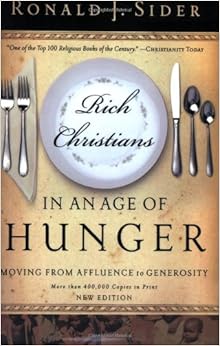
I picked up the book after our senior pastor had read it and shared some of the thoughts in some sermons this past summer. My initial thoughts at seeing the title and know just a little bit about Sider were that this would be a typical social justice, feed the poor, heavy on guilt and stats, light on Scripture type book. Unfortunately I've read those before and while I have agreed with the need for caring for the poor and outcast in our world, I wanted something with meat.
This is that book for me. Sider does share statistics. Lots and lots of statistics in the early chapters. At first it seems as though all the book would be about is statistics. You have to wade through that. But then Sider gets to the biblical section which dissects the passages about Jubilee, caring for the widows and orphans, the early church sharing things in common and other relevant scripture. He then goes on to discuss current economics and how they often marginalize the poor and offers practical and radical suggestions. Sider is not about suggesting fantastical solutions for a perfect world, but rather solutions that could be implemented in a broken, fragile world.
One of the interesting things about this book is that it was originally written back in the 1970's. Communism was still a serious contender with free-market economies. While Sider supports those Christians who have decided to share property in common, Sider defends free markets but wants to help all people have opportunities to work and to make a fair living. He argues that communism put economics and politics in the same hands and that didn't work. He does point out ways in which our current free-market economy is broken and favors those who already have wealth.
I would absolutely add this book to my list of must reads. There are parts that I had to stumble through and one section on economics that I found fascinating, but didn't really understand. Sider himself confesses that he is more of a theologian than an economist. But Sider confronts the materialism, commercialism and militarism of the western and northern (as Sider puts it) world. If the church genuinely cares about reaching the lost, the poor and the disenfranchised perhaps we should take seriously some of the suggestions offered by Sider.
Friday, September 19, 2014
SOD Farm: A Story to Retell

We felt challenged in some way to begin to live out some of these convictions of discipleship, accountability, community, thoughtful engagement with culture. One of the core questions was "How do we change 'What if' questions into 'Why not' questions?" We feel like Mechanic Grove has so much going for it. There is a lively discussion of people honestly seeking to follow Jesus. There is a place that takes ministry to the community seriously in its Children's Outreach Ministry. But perhaps we are also a people who speak frequently of discipleship and community without experimenting with the full ramifications of those words. So SOD Farm is perhaps one, meager attempt to experiment with this. It would be a radical step beyond what is "normal" ministry. I acknowledge that the details are far from finished, nor do I wish or think it right to figure out all the details by myself without the community of people. Others will have to live with the reifications. Others will have to place themselves on the altar willing to sacrifice for Jesus and his kingdom.
Tuesday, September 16, 2014
SOD Farm: Core Values
Unconditional Love - We believe all are welcome to come as you are with the expectation that you will leave differently than you came. We seek to model this love through hospitality towards those that would partner with us as well as those in our community need hospitality. We expect visitors at our table. We expect to see strangers at the farm. Romans 12:13 instructs us to share with those in need and practice hospitality.
Jesus-centered Worship - Jesus is the model for our lives. We seek to be citizens of his kingdom and to do the work of his kingdom. We approach the Bible with Jesus Christ at the center of our understanding. At the SOD Farm we engage in community worship each morning and afternoon with those living at or working at the farm. We also understand that we try to make everything we do an act or worship.
Faithful Service - The SOD Farm is a serve to the church as it seeks to educate disciples on living intentionally, with every area of life surrendered to Jesus. We seek to serve the local community through growing food for the local food bank, assisting those who are in need through education and to seek the general peace and prosperity of our local and global community. We believe we are called to live out our faith in actions.
Lifestyle Witness - We seek to model Jesus and the values of the kingdom of God through the way we live our lives. We try to be aware of our impact on the earth and on the people God loves. We believe that through living lives dedicated to Jesus and by teaching those around us about Jesus, others will be drawn to relationship and surrender to Jesus.
Developing Disciples - SOD Farm seeks to be a place where the church is challenged to think deeper about what real discipleship and surrender to Jesus means. We want to be a partner in raising a new generation of leaders that will impact the church and the world. We ask partners to commit to a new level of surrender and service and to grow through biblical training and engaging the world.
Anabaptist Heritage - We have a heritage connected to those once called "Radicals." They were called radical because of their complete surrender to Jesus and their intense drive to become better disciples of Jesus. These were a people connect to God, to each other and to the land. We uphold these convictions through seeking Jesus, being connected to one another and working closely with the earth. The SOD Farm connects with the local church through Brethren practices of foot washing, Love Feast, and baptism. We try to pursue peace between ourselves and our neighbors and our enemies. We try to live simply in order to provide more resources for others to simply live. We try to live connected to one another, understanding that is is in community that God exists and speaks.
Monday, September 15, 2014
SOD Farm: Who and What?
The School of Discipleship Farm would attempt to connect with people in a variety of ways. The primary way would be through Partners, age 18-30, who commit 10 months of their lives to come and learn and serve at the SOD Farm. The farm would connect with the Mechanic Grove congregation by learning from the experience of elders and serving alongside different ministries of the church. SOD Farm would also seek to be a place that connects with those in need in the community and provide resources and education.
What is it?
SOD Farm is an intentional community of disciples who commit 10 months of their lives to come and live, learn, serve and explore in community. This that come to SOD Farm would find a curriculum focused on Bible training, cultural engagement and seeking the peace and prosperity to the place we have been called to live. Partners would learn how to connect their faith in everyday work on the farm, growing and preserving food for themselves and others through the local food bank. They would also be a part of serving neighbors through community service and volunteering in the local church. The partners that come to SOD Farm will commit themselves to live by a Rule of Life focused on serving God and serving others in Christian community.

What is it?
SOD Farm is an intentional community of disciples who commit 10 months of their lives to come and live, learn, serve and explore in community. This that come to SOD Farm would find a curriculum focused on Bible training, cultural engagement and seeking the peace and prosperity to the place we have been called to live. Partners would learn how to connect their faith in everyday work on the farm, growing and preserving food for themselves and others through the local food bank. They would also be a part of serving neighbors through community service and volunteering in the local church. The partners that come to SOD Farm will commit themselves to live by a Rule of Life focused on serving God and serving others in Christian community.

Monday, September 8, 2014
SOD Farm
Have you ever wondered if Jesus really meant the stuff he said? What if he meant "Go and make disciples"? What if he meant all that stuff about loving your neighbors (and even enemies)? What might it look like for the church to live some of this out in radical obedience?
Some of us at Mechanic Grove have been asking those same questions. In our world; in our culture, what would it look like?
Enter SOD Farm. This is a new idea at Mechanic Grove, but one which is very much in line with our tradition, our core values and our calling.
SOD Farm is short for School of Discipleship Farm. What we are trying to do is have a place that takes discipleship very seriously. It's not that the rest of the church doesn't take it seriously, but this would be an experiment in costly discipleship.
The idea is to have a farm where people commit 10 months of their lives to come and live in community, learn the Bible and theology, serve the community and larger congregation, and explore what God is doing in the world. These partners would come to live at the farm and work the farm. They would engage with rigorous biblical and theological training. They would also serve in different community ministries such as food banks, rescue missions, etc. as well as different ministries of the church. My hope is that they would also get three cross-cultural experiences during the 10 months as well.
In the coming posts we'll explore some of the questions that need some answering as we begin this journey.
Some of us at Mechanic Grove have been asking those same questions. In our world; in our culture, what would it look like?
Enter SOD Farm. This is a new idea at Mechanic Grove, but one which is very much in line with our tradition, our core values and our calling.
SOD Farm is short for School of Discipleship Farm. What we are trying to do is have a place that takes discipleship very seriously. It's not that the rest of the church doesn't take it seriously, but this would be an experiment in costly discipleship.
The idea is to have a farm where people commit 10 months of their lives to come and live in community, learn the Bible and theology, serve the community and larger congregation, and explore what God is doing in the world. These partners would come to live at the farm and work the farm. They would engage with rigorous biblical and theological training. They would also serve in different community ministries such as food banks, rescue missions, etc. as well as different ministries of the church. My hope is that they would also get three cross-cultural experiences during the 10 months as well.
In the coming posts we'll explore some of the questions that need some answering as we begin this journey.
Monday, March 11, 2013
Surprised by Hope

It's a provocative book from the start. Right away I thought the title should be changed to "Rediscovering Heaven, the Resurrection and the Mission of the Church." While many of the ideas presented may seem new to Western Evangelicals, they are, as Wright argues, the beliefs of Jesus, the New Testament and the early church. Wright is not breaking new ground completely as much as helping the church understand what was intended by the resurrection language of the New Testament writers.
Wright argues that when we die we our souls receive rest and refreshment in the presence of God. Perhaps you can call it heaven, but it is only the first part of a two stage process. He discusses the current view of disembodied souls going to an other-worldly heaven as a current form of Gnosticism which believes that matter is essentially evil. Wright suggests that the true hope of Christians is not in our souls leaving this place and the earth being destroyed by God in favor of a matter-less heaven. What the New Testament, Jesus and the early church were far more interested in was the Resurrection and restoration of the created order. God created a good creation in the beginning and his goal is to redeem and restore not to destroy that creation. Ultimately the hope of Christians is that of a bodily resurrection and restoration of creation when Christ returns to fulfill and complete his kingdom on earth which has already begun.
Wright combats the gnosticism of current views of heaven as well as the escapist rapture theology made popular in American Evangelical circles by Hal Lindsay (Late, Great Planet Earth) and the Left Behind books and movie series. In these views God will destroy the created order and whisk his chosen to a heaven somewhere else. Wright suggests that heaven is not really somewhere else, but that the realms of heaven and earth can be thought of as concentric circles with the goal of one day heaven and earth becoming fully visible to one another.
Wright briefly discusses purgatory and hell. He tears down the traditional idea of purgatory and says little about hell. He leaves room for a final judgement, but casts judgement in a positive light as the wrongs of the world are made right. Judgement is not primarily a vindictive act. Rather the longing for judgement throughout the Bible is for God to correct the wrongs of the world.
In the end, Wright talks about how our hope for the resurrection and restoration as God's "kingdom comes on earth as in heaven" affects our thinking of salvation (no more eyes closed, hand raised magical "sinner's prayer"), building of the kingdom and mission of the church.
There's a lot in this book and too dense for such a short summary. Go read the book. It's great stuff. The conclusion is that this life matter so much more than most Western Evangelicals want to admit. Christians have a responsibility to seek Justice, Beauty and Evangelize (bear witness to the true hope of the Gospels and live as colonists of the kingdom now). Wright believes that the things we do to reveal and expand the kingdom not only in human lives, but in the whole created order as well, will somehow be carried over in a redeemed state into God's marriage of heavens and earth. Christians have a responsibility to care for the justice of the outcast and poor. We have a responsibility to care for creation and help to see it restored.
Wright voices many of the concerns I've had in the last few years of pop-Christianity and its love affair with escapism and reducing the human being to a disembodied soul. How can God look down at Creation and declare everything "good" only to have us believe that Revelation is about God destroying that good creation. Wright points out that the final picture of the Revelation of John the Seer is of heaven coming down to earth and God making his dwelling among man. It's described as a great wedding between heaven and earth that were made for one another. Go Read this Book!
Wednesday, August 29, 2012
The Naked Anabaptist
It's been quite a while since I've posted anything. Recently I finished reading The Naked Anabaptist: The Bare Essentials of the Radical Faith. If you're thinking "Amish gone wild" or "I knew there was something screwy about those Brethren," sorry to disappoint.
Stuart Murray is an Anabaptist writing from England. His book is a look at the basic principles of the Anabaptist tradition. He wanted to look at the Anabaptist faith when it's not clothed in Amish or Mennonite clothing and traditions (hence, "Naked Anabaptist"). At the start he deals with some common misconceptions or ideas of Anabaptism. They are questions Murray hears often being a part of the Anabaptist Network in England where Anabaptism has not traditionally been a part of the religious make-up.
The rest of the book is mostly spent looking at seven core convictions of Anabaptists.
Stuart Murray is an Anabaptist writing from England. His book is a look at the basic principles of the Anabaptist tradition. He wanted to look at the Anabaptist faith when it's not clothed in Amish or Mennonite clothing and traditions (hence, "Naked Anabaptist"). At the start he deals with some common misconceptions or ideas of Anabaptism. They are questions Murray hears often being a part of the Anabaptist Network in England where Anabaptism has not traditionally been a part of the religious make-up.
The rest of the book is mostly spent looking at seven core convictions of Anabaptists.
- Jesus is our example, teacher, friend, redeemer, and Lord. He is the source of our life, the central reference point for our faith and lifestyle, for our understanding of church, and our engagement with society. We are committed to following Jesus as well as worshipping him.
- Jesus is the focal point of God’s revelation. We are committed to a Jesus-centered approach to the Bible, and to the community of faith as the primary context in which we read the Bible and discern and apply its implications for discipleship.
- Western culture is slowly emerging from the Christendom era, when church and state jointly presided over a society in which almost all were assumed to be Christian. Whatever its positive contributions on values and institutions, Christendom seriously distorted the gospel, marginalized Jesus, and has left the churches ill equipped for mission in a post-Christendom culture. As we reflect on this, we are committed to learning from the experience and perspectives of movements such as Anabaptism that rejected standard Christendom assumptions and pursued alternative ways of thinking and behaving.
- The frequent association of the church with status, wealth, and force is inappropriate for followers of Jesus and damages our witness. We are committed to exploring ways of being good news to the poor, powerless, and persecuted, aware that such discipleship may attract opposition, resulting in suffering and sometimes ultimately martyrdom.
- Churches are called to be committed communities of discipleship and mission, places of friendship, mutual accountability, and multivoiced worship. As we eat together, sharing bread and wine, we sustain hope as we seek God’s kingdom together. We are committed to nurturing and developing such churches, in which young and old are valued, leadership is consultative, roles are related to gifts rather than gender, and baptism is for believers.
- Spirituality and economics are interconnected. In an individualist and consumerist culture and in a world where economic injustice is rife, we are committed to finding ways of living simply, sharing generously, caring for creation, and working for justice.
- Peace is at the heart of the gospel. As followers of Jesus in a divided and violent world, we are committed to finding nonviolent alternatives and to learning how to make peace between individuals, within and among churches, in society, and between nations.
This is not an overly scholarly book. Murray and his network are trying to provide resources for the emerging Anabaptists in England and Ireland. I appreciated his critique of Christendom (the time from the 4th Century conversion of Constantine through the late 20th Century) when the church and state together controlled society. He admits that there was good that came out of that period, but that in general it was not an idea that was faithful to Christ's sacrificial love. Part of the reason for his admiration of Anabaptism is its noncompliance with Christendom ideology. He sees Anabaptism as a movement focused on Jesus-centered discipleship whose moment in church history has finally come. Murray confesses weaknesses of Anabaptism but evaluates it positively.
For anyone who wants to be introduced to Anabaptism, for Anabaptists who don't know where they come from, for those longing to be part of a community which worships and follows Jesus, I would highly recommend giving it a read. It's challenging whether you are an Anabaptist or not.
Wednesday, May 30, 2012
Christian History
It's been a while since I've written a book review. This is probably because with a baby, garden on top of everything happening at church, I haven't had time to read a whole lot. What I have been reading is a Quicknotes version of Church History. I decided it was about time I refreshed my memory of some of the things that are a part of our history as the church. This isn't really a review of the book itself. The authors/editors do a good job of giving a brief overview of primarily Western church history. It offers a few value judgements of history, some of which I agree with and others I don't.
The history moves from the early, primitive church in Acts through the Roman persecution, theological developments, Middle Ages, into the Reformation, Great Awakening and finally ends with the 20th Century development of "Evangelical" Christianity in the West and also offers a look and guidance for the church in the 21st Century.
What comes to life is a twisted history in the institutional church. The church begins as a movement of people trying to live as members of the kingdom of God. They were persecuted by Roman and Jewish authorities at the start. With Constantine, all of that subversive, underground, Christ-following movement becomes powerful. Church and State become united and remain that way until the secularization of the Enlightenment begins. There are major developments that occur in the theology of the church as it develops.
One thing I found interesting was the development of the Reformation. Martin Luther is often credited as starting the Reformation. This review of history also points out those that paved the way for the Reformation such as John Wycliffe and Jan Hus. It also talks about the developing of state churches following Luther, Calvin or Catholicism. The book also goes into some detail of the Radical Reformers which developed Anabaptism. Anabaptists suffered persecution under the state churches whether Lutheran, Calvinist or Catholic.
The book concludes by looking at the effects of the Enlightenment on the church. It then talks about the evangelistic movements of the 19th and 20th Century. They also mention that eventually Evangelical Christianity began to divorce the social and spiritual Gospel. For centuries the faithful church had sought ways to reform societies ills while also seeking to bring people to Christ. They were one in the same. During the 20th Century the church began to split the gospel.
Two things become clear by looking at church history. The first is that the church with worldly power is really no different than the world with worldly power. The only difference is that the church with worldly power assumes God has ordained it. When the church identifies with the the outcasts and speaks prophetically to centers of power, then it is faithful and grows. The church and state relationship does not work. The second thing that becomes clear is that the church has one Gospel to live out. Jesus fed people with bread and told them he was the bread of life. He cared for people's physical and spiritual needs. One Gospel. Jesus has come to change the world. Physical or Spiritual. Everything comes under Jesus. The Church, then, must do likewise. We look for ways to help the disenfranchised, poor and outcasts while reconciling people to Christ. When the church tries to use the power of the state or fragments the Gospel it begins to turn away from faithfully following Christ.
The history moves from the early, primitive church in Acts through the Roman persecution, theological developments, Middle Ages, into the Reformation, Great Awakening and finally ends with the 20th Century development of "Evangelical" Christianity in the West and also offers a look and guidance for the church in the 21st Century.
What comes to life is a twisted history in the institutional church. The church begins as a movement of people trying to live as members of the kingdom of God. They were persecuted by Roman and Jewish authorities at the start. With Constantine, all of that subversive, underground, Christ-following movement becomes powerful. Church and State become united and remain that way until the secularization of the Enlightenment begins. There are major developments that occur in the theology of the church as it develops.
One thing I found interesting was the development of the Reformation. Martin Luther is often credited as starting the Reformation. This review of history also points out those that paved the way for the Reformation such as John Wycliffe and Jan Hus. It also talks about the developing of state churches following Luther, Calvin or Catholicism. The book also goes into some detail of the Radical Reformers which developed Anabaptism. Anabaptists suffered persecution under the state churches whether Lutheran, Calvinist or Catholic.
The book concludes by looking at the effects of the Enlightenment on the church. It then talks about the evangelistic movements of the 19th and 20th Century. They also mention that eventually Evangelical Christianity began to divorce the social and spiritual Gospel. For centuries the faithful church had sought ways to reform societies ills while also seeking to bring people to Christ. They were one in the same. During the 20th Century the church began to split the gospel.
Two things become clear by looking at church history. The first is that the church with worldly power is really no different than the world with worldly power. The only difference is that the church with worldly power assumes God has ordained it. When the church identifies with the the outcasts and speaks prophetically to centers of power, then it is faithful and grows. The church and state relationship does not work. The second thing that becomes clear is that the church has one Gospel to live out. Jesus fed people with bread and told them he was the bread of life. He cared for people's physical and spiritual needs. One Gospel. Jesus has come to change the world. Physical or Spiritual. Everything comes under Jesus. The Church, then, must do likewise. We look for ways to help the disenfranchised, poor and outcasts while reconciling people to Christ. When the church tries to use the power of the state or fragments the Gospel it begins to turn away from faithfully following Christ.
Tuesday, May 15, 2012
Weeds, the Fall and More
So today is a collection of a few scattered thoughts I've had while working around my garden and yard. Right now with the rain we've been having my garden is looking pretty good. I'll have to take some pics and upload them. My potatoes are thriving, my beans are coming up, lettuce almost ready, carrots coming up sunflowers growing and everything else looking good.
With taking care of my garden and yard I've been pulling up weeds. I started thinking about the significance of weeds as pertains to my walk with Christ. My thoughts came to Matthew 13:24-30 and the Parable of the Weeds. In the story Jesus talks about the Kingdom being a place where the wheat and weeds grow together for a time. The servants ask if they should separate them. The owner instructs to allow them to grow together and separate them at the harvest. Jesus goes on the explain the parable in verses 36-43. As I was pulling weeds I was thinking about people in my life who right now at least appear to be weeds. So I prayed for the weeds that I know that they may be shown to be wheat.
Another random thought I had came about because of the lovely poison ivy now irritating my fingers. Why do we have things like poison ivy? It's similar to questions I've asked about the purpose of mosquitoes or other parts of creation that seem to just be a nuisance. Perhaps poison ivy does serve some good purpose. I sure would like to know what it is. For right now it's a painful reminder of the Fall. The event and events that make up the Fall are all around. I think of poison ivy as something that's not right; as part of creation that is fallen in its purpose. We see people around the world torn apart from God and from each other as a result of the Fall. People hurting, creation groaning waiting for the Fall to be permanently made right. The poison ivy is reminding me of my own fallenness. I say "event and events" because at times we like to blame Adam for humanities fallenness. But I have to admit my compliance with Adam's decision to turn from God every time I turn away from God myself.
I'd like to think that gardening is all great. But the reality is that there are hard things to deal with in the garden. There are weeds that will be destroyed, so I pray for the weeds hoping they might turn out to be something different. And there's poison ivy reminding me that all is not right yet with Creation or with my own relationship with Christ.
With taking care of my garden and yard I've been pulling up weeds. I started thinking about the significance of weeds as pertains to my walk with Christ. My thoughts came to Matthew 13:24-30 and the Parable of the Weeds. In the story Jesus talks about the Kingdom being a place where the wheat and weeds grow together for a time. The servants ask if they should separate them. The owner instructs to allow them to grow together and separate them at the harvest. Jesus goes on the explain the parable in verses 36-43. As I was pulling weeds I was thinking about people in my life who right now at least appear to be weeds. So I prayed for the weeds that I know that they may be shown to be wheat.
Another random thought I had came about because of the lovely poison ivy now irritating my fingers. Why do we have things like poison ivy? It's similar to questions I've asked about the purpose of mosquitoes or other parts of creation that seem to just be a nuisance. Perhaps poison ivy does serve some good purpose. I sure would like to know what it is. For right now it's a painful reminder of the Fall. The event and events that make up the Fall are all around. I think of poison ivy as something that's not right; as part of creation that is fallen in its purpose. We see people around the world torn apart from God and from each other as a result of the Fall. People hurting, creation groaning waiting for the Fall to be permanently made right. The poison ivy is reminding me of my own fallenness. I say "event and events" because at times we like to blame Adam for humanities fallenness. But I have to admit my compliance with Adam's decision to turn from God every time I turn away from God myself.
I'd like to think that gardening is all great. But the reality is that there are hard things to deal with in the garden. There are weeds that will be destroyed, so I pray for the weeds hoping they might turn out to be something different. And there's poison ivy reminding me that all is not right yet with Creation or with my own relationship with Christ.
Friday, May 4, 2012
Letter to the Exiles
In my continuing search through the Bible for references to gardens, growing, seeds, etc. I came across this section of scripture, Jeremiah 29:1-14. It's a letter written to those Jews who were in in exile in Babylon. In it Jeremiah instructs the people to take up residence. They are to build homes, grow gardens, give their children in marriage and continue to grow as a people. The people are also instructed to "seek the peace and prosperity of the city..." Today we see the church in a kind of exile. At times being unfaithful and finding ourselves wandering, looking for home. But God has put us in the place we live for a reason and perhaps his word to us is much the same as it was to them. To take up residence, raise our children even to grow gardens and certainly to seek the peace and prosperity of where we live. Now I have to confess that the prosperity part isn't so hard in America, but I do know of lots of people living around me that are in need. There are different ways in which our community of faith is working at seeking the peace and prosperity for all in the place we live. We help with unmet bills, child care, food and other outreach to our local community. We also work at sharing peace with our community and the world by being an active voice for non-violence. We are working at making our area look more and more like the Kingdom.
What does growing gardens have to do with the peace and prosperity of the city? I'm not sure what Babylon was like, but if it's anything like American cities today I can see why gardening was part of the seeking peace and prosperity. I've recently been talking with a number of people at Mechanic Grove about gardening and the importance of teaching the next generation to garden. As we have "progressed" in society we have moved away from the earth. We've forgotten where food comes from, the work that goes into it. We have forgotten the lessons that we learn from the garden like patience, taking your time, life from death. Perhaps teaching people again to grow food, to work in a garden, to learn basic life skills it part of the "peace and prosperity."
In Jeremiah 29:1-14, verse 10 begins a shift. God is talking about bringing his people back from exile and restoring them. To me there's a difference between seeking the peace and prosperity of the place I live and coming to believe Babylon is home. There's a danger in getting too wrapped up in whatever nation we find ourselves in exile. Perhaps in some places the Jewish people became content with Babylon. It was the world power of its time. It would have been easy to see the affluence and prosperity in Babylon and begin to think that it had been chosen or especially blessed by God. Babylon is not home.
What does growing gardens have to do with the peace and prosperity of the city? I'm not sure what Babylon was like, but if it's anything like American cities today I can see why gardening was part of the seeking peace and prosperity. I've recently been talking with a number of people at Mechanic Grove about gardening and the importance of teaching the next generation to garden. As we have "progressed" in society we have moved away from the earth. We've forgotten where food comes from, the work that goes into it. We have forgotten the lessons that we learn from the garden like patience, taking your time, life from death. Perhaps teaching people again to grow food, to work in a garden, to learn basic life skills it part of the "peace and prosperity."
In Jeremiah 29:1-14, verse 10 begins a shift. God is talking about bringing his people back from exile and restoring them. To me there's a difference between seeking the peace and prosperity of the place I live and coming to believe Babylon is home. There's a danger in getting too wrapped up in whatever nation we find ourselves in exile. Perhaps in some places the Jewish people became content with Babylon. It was the world power of its time. It would have been easy to see the affluence and prosperity in Babylon and begin to think that it had been chosen or especially blessed by God. Babylon is not home.
Monday, April 23, 2012
Well-watered Garden
This Spring has been very warm and dry. I love the warm part. We've had some B-E-A-utiful days this Spring. But after a while of no rain you start to see some consequences. I have a number of things already planted in my garden. My lettuce is coming up, my broccoli is starting to do better, my peppers are hanging in and a few others things are doing well. My trash-can potatoes are doing awesome. There really hasn't been much rain to keep things watered, so I've had to go out every day either with my watering bucket or the hose to water the garden. I also planted grass seed in a few bare spots in our yard that I've had to water. For a while things were looking pretty dry. The dirt in the garden was dry. The places I had planted grass were very dry and hard.
But Saturday night it started raining and today (Monday) it's still raining. I came across this Scripture: "The LORD will guide you always; he will satisfy you needs in a sun-scorched land and will strengthen your frame. You will be like a well-watered garden, like a spring whose waters never fail" (Isaiah 58:11). The rain has been great for the garden and the yard and our flower beds. I'm looking forward to seeing how things will grow once the sun comes out again. Far more comforting is knowing that God satisfies my needs. He gives me refreshment and new life when I feel dried out and sun-scorched. There have been times this Spring, while working in the garden or yard, where I've just reflected on everything God has blessed me with. My wife and son, my home and food, my church family, my job. In these times I feel refreshed and renewed. I know that God has blessed me in order for me to be a blessing.
Thank you God for rain. For watering the garden and helping things to grow. Thank you for the refreshment you send into my life and for the way you satisfy my needs. Amen
But Saturday night it started raining and today (Monday) it's still raining. I came across this Scripture: "The LORD will guide you always; he will satisfy you needs in a sun-scorched land and will strengthen your frame. You will be like a well-watered garden, like a spring whose waters never fail" (Isaiah 58:11). The rain has been great for the garden and the yard and our flower beds. I'm looking forward to seeing how things will grow once the sun comes out again. Far more comforting is knowing that God satisfies my needs. He gives me refreshment and new life when I feel dried out and sun-scorched. There have been times this Spring, while working in the garden or yard, where I've just reflected on everything God has blessed me with. My wife and son, my home and food, my church family, my job. In these times I feel refreshed and renewed. I know that God has blessed me in order for me to be a blessing.
Thank you God for rain. For watering the garden and helping things to grow. Thank you for the refreshment you send into my life and for the way you satisfy my needs. Amen
Tuesday, April 3, 2012
Sustainable Living?
Last week I was working on mulching our flower beds around the house. This is the first year that I've been responsible for edging, mulching and maintaining my own flower beds. It's a treat, once it's done. But as I talked about earlier, work is not a bad thing. I was reflecting again on the Creation story that begins in a garden. Today you hear a lot about Sustainable Living. It's a big deal because the way much of the world is living cannot continue. During the industrial revolution the church developed a theology of Dominion over creation rather than stewardship of creation. We've stripped the land, developed unhealthy, unnatural practices and over-all degraded God's good creation. So sustainable living is a step in the right direction.
But in the Creation Story God says "be fruitful" (Gen. 1:28) and the writer states God placed the man in the garden to "work it and take care of it" (Gen. 2:15). It seems that God intended life to multiply for growth and expansion. And for it to be done in harmony with the rest of creation. Today we're just hoping that we can hand something down to the next generation through sustainable living.
A few years ago a the Grove we started a recycling ministry. We recycle paper in the office and used bulletins as well as plastic, metal and glass containers in the kitchen and old magazines. I remember when we started that the group said if anyone should care about Creation and being green, it's Christians. We should be the ones leading the way in being stewards of God's creation. It doesn't mean that we can't use resources that God has provided for us, but that we should use those resources in a responsible way. The way we live should be fruitful and multiply for the next generation. What if all Christians would take a look at our resources and practices and seek for the best way to honor God in those ways. Perhaps we would change from just being sustainable to being fruitful and multiplying.
Resurrection!
I always look forward to Easter. From Palm Sunday through Love Feast and Communion on Thursday, Black Friday and of course Easter Sunday. When I was a little kid I was excited because it meant an Easter basket (or paper bag) with candy. We also would get a chocolate cross from church made of snickers and milky way candy bars fused together with icing decorations on top. But Easter has changed as I've gotten older. Now I have a better understanding of what it means for my faith. This past Palm Sunday we celebrated the coming of the king into Jerusalem. The Jews intended to crown and earthly king. Instead it becomes the inauguration of a different kind of kingdom. This Thursday the Mechanic Grove community will celebrate Lovefeast and Communion. This year will be a little different as we celebrate with hispanic brothers and sisters from Lancaster. We will enact Isaiah 56:7 that says God's house will be a house of prayer for all nations. It will be a new look at the church and seeing different people groups united in communion. Friday I will reflect on Christ's sacrifice on the cross. Not only his sacrifice but also his crowning (I wrote about this previously here).
But this year I am especially looking forward to celebrating Resurrection Sunday. Jesus' triumph over sin and death. New, restored, completed, perfected life. It seems like a different part of Holy Week impacts me each year. And this year it is Resurrection. It's probably because of loss I've experienced this year. In the last year I lost a good friend that I grew up with, went to church with, played baseball with, sang with. I also lost my big brother Bob (Theology of a Hug). Last week we lost my wife's grandmother in a car accident. She was a beautiful woman. Since my grandparents live in Ohio, she was my "Granny" too. 1 Thessalonians 4:13-14 instructs us not to grieve as those with no hope. Instead we look forward to final resurrection and to seeing those that have "fallen asleep." This year as I get closer to Resurrection Sunday I can't help but be thankful, hopeful, and very, very grateful for Resurrection. Enjoying life everlasting with Jesus, Glenny, Bob, Granny and others.
Thank you God for your Son. Thank you for sending him to restore our relationship with you and for giving us life renewed, restored and resurrected with You. Amen!
Tuesday, March 27, 2012
It Begins in a Garden
Reading Scripture while growing a garden seems like there is only one logical place to begin. After all the story of God's relationship with humanity begins in a garden. Imagine the beauty of God's perfect garden. I've seen some nice gardens. We have a place near us called Longwood Gardens. It's beautiful with something different in each season, but I know it's not perfect like God's garden.
I always assumed that work came after the Fall. That Adam and Eve just enjoyed the garden without having to do anything. But Genesis 2:15 says, "The LORD God took the man and put him in the Garden of Eden to work it and take care of it." So even before the Fall man did work. After the Fall God explains that now they will toil and sweat to work the land. Work in and of itself is a good thing. I'll try and remember that when I'm sweating this Summer or my back hurts from pushing the wheel barrow filled with dirt or mulch all over the yard.
Why does it start in a garden? Why not a city of people where God can enjoy the company of many? Why in a garden? It occurs to me that life happens much slower in a garden. A garden requires patience and time. You can't be in a hurry with a garden. On the other hand, cities are busy. There's always something happening; always places to run and things to do. My life tends to be more like a city. I feel like there's always something to get done. There's something at the church going on. Some family event. Bills to pay, errands to run. But God chooses a garden. He walks in the garden and has long conversations with Adam and Eve. There aren't things to rush off to. Just time to spend enjoying the garden and relationship with God.
Lord, You walked with Adam and Eve in the garden. They moved at the pace of a garden, slowly and intentionally. Help me to slow down and take time to spend walking in the garden with You. Thank you for the gifts and abilities to work!
Monday, March 26, 2012
Lesson in Peace
Last night at the Grove we hosted Beatrice Mambula and her parents, Mosa and Sarah, to talk about what is happening to the Church of the Brethren in Nigeria (EYN). Currently they are undergoing persecution at the hands of radical fundamentalist Muslims. They shared a number of stories about the persecution. In 2009 several EYN churches were destroyed in fires. They shared that there is again renewed violence against Christian churches, the government and even schools now. Today Christians going to church on Sunday mornings must be patted down and searched before entering the church by armed soldiers. Women are not allowed to carry purses because it is feared they are carrying bombs. They don't even park in their church parking lot anymore. Instead they park in protected parking lots and walk to church. The president of Nigeria has acknowledged that part of this radical sect has infiltrated different sectors of the government agencies and are funded by powerful politicians, banks and outside organizations. The group has set out to destroy Christian churches bearing the cross, the government, Western education and even moderate Muslims who are sympathetic to the persecution of the Christians.
Despite the stories of persecution there were also stories of hope shared. Back in the 80's when the church first went through persecution and 107 churches were burned the church leaders decided to rebuild. As they collected money to rebuild their churches they decided before they rebuilt their churches to rebuild 3 mosques that had been burned by other Christians. The Muslims didn't know how to respond to this. Many were puzzled by this response. Several of these Muslims became Christians and are now involved in missions to Muslim areas. The Mambula's also shared that Christians and Muslims are beginning to work together to overcome this hatred of a a radical sect. Christians go to the Muslim mosques on Friday to protect the Muslims during their time of prayers. Muslims in turn come and protect Christian churches on Sunday mornings. They are working together.
I've talked about pacifism and non-violence before. But it's a lot easier to say when there's nothing that threatens my life. To hear how the EYN is pursuing peace in the midst of persecution is a testimony to their faith and love of Jesus Christ. When you ask if they want to fight and defend themselves, they say, "We're humans. We want to fight back. But we love Jesus and this love will not allow us to fight." Instead they realize as Paul writes in Philippians 1, "To live is Christ, and to die is gain." They look forward with expectation to be a part of Christ's kingdom with final peace.
I was very blessed by their presence and to see their faith, hope and love. They continue to work at loving their enemies and turning the other cheek.
Wednesday, March 14, 2012
Growing Disciples

First of all let me start by saying I am in no way a great gardener. I remember working in our family garden when I was a little kid. I've had a garden the last couple of Summers with varied success at growing different things. We've had our garden as a part of the farmer's field at the house we were renting. It was great ground. We never had to till anything. Last Summer we moved into our own home. So this year I'm trying something different. I'll be building some raised beds for my garden. I'm also trying some different things.
So what's this all about and why I am writing blogs about it? My hope this Summer is to learn more about gardening, but in the process learn more about God. Gardening seems like one of the most natural ways to learn about the Kingdom. After all, it begins with a Garden, Jesus talks about the kingdom being like a seed, harvesting and all kinds of agricultural examples of the Kingdom and faith. This is an exercise in faith hopefully as much as it is an education in gardening.
From my garden I'm hoping to provide my family with good, nutritional food and lower my grocery bill. Hopefully my trash can potatoes will turn out ok. I'd be delighted if I manage to get a few peanuts. And I'm looking forward to making my own salsa from my tomatoes, onions and Jalapeno peppers.
I'm also hoping that my garden can help teach me about patience, cultivating faith, how the Kingdom spreads and more. Over the Summer I'm hoping to post progress on my garden with pictures and some insights and Scripture that I'm coming across that pertain to the garden.
I would encourage your comments and insights along the way.
Monday, November 28, 2011
Isaiah's Prophecy
Yesterday Pastor Jim had a great sermon on Isaiah 7:1-17. In this section of Scripture is the often quoted prophecy of the virgin birth of the Messiah. Pastor Jim talked about the immediate context of the text from Isaiah. Israel and Syria were coming against Judah to coerce Judah into joining their side against the Assyrians. Isaiah gives the sign from God, "The virgin will conceive and give birth to a son, and will call him Immanuel." Pastor Jim pointed out that there are two meanings in this prophecy. There is the immediate context of Judah receiving a sign as well as the larger context of the Messiah being born of a virgin. What we didn't get into was the fulfillment aspect of the two prophecies. Because of the Advent season our focus of course was on the Immanuel and the meaning of "God is with us." God is with us no matter where we are or what situation we find ourselves in whether relying on God when nations come against us as in the case of Ahaz, king of Jersusalem, or dealing with some every day situation today.
But I want to dig deeper and come back to the two prophecies for a minute. Prophets were true prophets because what they predicted always came true. Prophets whose messages didn't come true were known as false prophets. So I must assume that Isaiah's prophecies came true. My question is, "Are there two fulfillments of this prophecy?" Is there an immediate or close at hand fulfillment of Isaiah's words which was recognized by his first hearers and also the larger prophecy of the virgin birth of Jesus? Or is there only one fulfillment of the prophecy and in that case how was that a comfort and sign to Ahaz 700 years earlier?
Either answer draws me to a few deeper issues. If there is an immediate fulfillment what does that mean for the "virgin birth." It has been suggested by some commentators that "virgin" can also be translated, "young maiden." Perhaps Isaiah meant this in his immediate context. The Gospels point out that Mary and Joseph did not consummate their relationship until after the birth of Jesus (Matt. 1:25). Is there historical evidence of an immediate fulfillment? Some suggest that Hezekiah (son of Ahaz) or Sheab-Jashub (son of Isaiah) as the immediate fulfillment. Both pose some problems.
Any thoughts?
This is what fascinates me about the Bible. So much going on. I also ran across a note that asked, "Why Ahaz?" Why does this message of the Messiah come to Ahaz who is not the best example of a king? God's message of love, hope, and redemption comes to use no matter who we are or how imperfect we are. So when we read the Bible, even familiar texts, read with open and new eyes to see what the Word is telling us.
Subscribe to:
Posts (Atom)